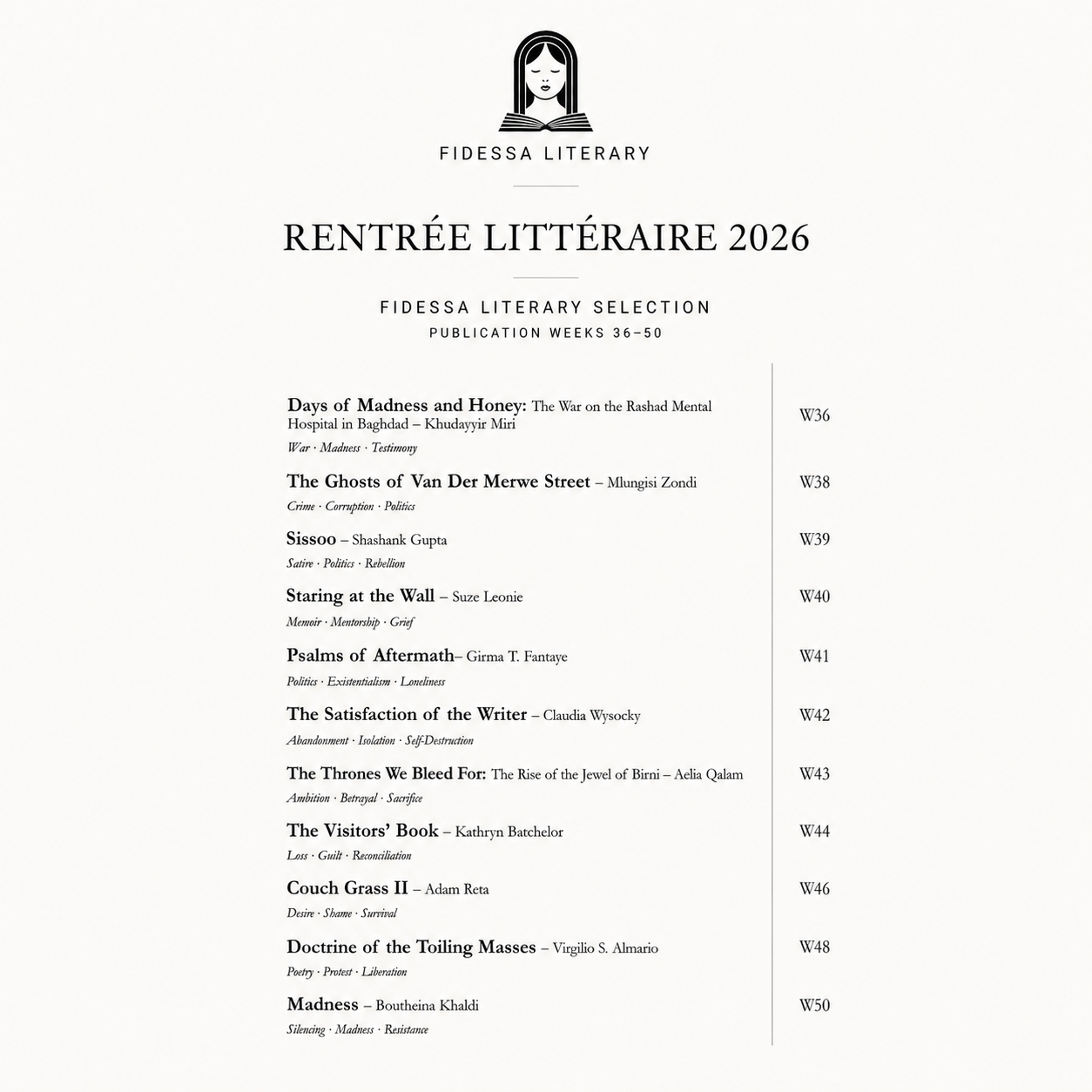
Fidessa Literary Selection 2026
Bloodhive
Three handicapped girls are killed by a large bird. The inhabitants of Didoli, a quiet hill-town, are scared to venture out. Particularly terrified is Yagya, an amputee. Her husband suspects that the murderer is a recluse called Kuriachen, who has the arms of a gorilla and two sickly stick-like polio legs, but has learnt to fly with a monstrous pair of steel wings.
Kuriachen has sacrificed his ear, an eye and the organs of sexual pleasure to make his bloodhive – his heart – far superior. He charms and whisks Yagya away to his strange mountain-top lair swarming with bees. And later, when he lops off his tongue to gain more power, she becomes the voice to his telepathic commands.
Someone Was Here
Haunted by the death of his young daughter and estranged from his wife, a grieving man begins an affair with a younger woman—but it is not the woman who consumes him. Instead, he becomes obsessed with the apartment where they meet, drawn to the absent owner’s belongings and the traces of her presence. The space offers him a fragile sanctuary, echoing how he has preserved his daughter’s room. As his fixation deepens, memories of a troubled childhood and the reappearance of an old friend unsettle his grasp on reality, blurring memory and obsession. When the apartment is no longer available, his fragile refuge collapses, propelling him toward a final, irrevocable act. At once a meditation on grief, absence, and the unreliability of memory, the novel traces a mind unraveling in its desperate attempt to resist the dissolving weight of loss.
Messenger From Before
In 1980s Warwickshire, Ciara lives with her guardian, Angie, a woman of prestige, discipline, and secrets. Angie’s past is a mystery she reveals to no one. When Ciara searches for clues about her family’s history, she stumbles upon a hidden collection of old letters written by Angie. Curiosity pulls her into a past that feels larger, stranger, and more tragic than she ever expected. As she pieces together the fragments, Ciara is drawn into a long-buried story, shifting between the everyday rhythms of her present and the shadowed echoes of another time. What begins as a private search for answers becomes a tense reckoning with identity, forcing her to face an ultimate choice: selflessness or salvation.
Melancholy of the Tongue
Lumbay ng Dila follows Sadyah Zapanta Lopez, a twenty eight year old teacher in Manila whose life is jolted by a headline from home: her grandfather, former assemblyman Marcelo Nones Lopez, has been acquitted after a twenty one year trial tied to the nineteen eighty four Guinsang an Bridge Massacre. With the verdict comes a sharper, more personal question that has haunted her since childhood: what really happened to her mother, Teresa Zapanta Lopez, known in the movement as Kumander Rafflesia, who vanished after the violence and the years of fear that followed.
Drawn back to Barasanan in Dao, Antique, Sadyah tries to rebuild a life among kin and memory while opening the Balay Sugidanun, a home for stories. Moving between province and city and as far as Bangkok with her lover Priya Iyer, she gathers documents, testimonies, and fragments of the past until family, politics, and desire collide, and language itself becomes both wound and refuge.
The Satisfaction of the Writer
Seventeen year old Matteo has spent his life learning how to stay unnoticed. After being abandoned and bounced through foster homes, he is left effectively on his own, carrying a fragile routine and a mind that does not always cooperate. The one place that feels steady is the school writing club, where he can hide in plain sight and pour what he cannot say into a detective story about a boy searching for missing parents.
When Matteo’s grip on everyday life starts to slip, the lines between fiction and threat, care and control, begin to blur. Misunderstood by the people around him and pulled into a system that treats symptoms more harshly than it treats causes, Matteo clings to the only thing that still feels like his. The Satisfaction of the Writer is a dark, intimate coming of age story about abandonment, stigma, and the thin shelter art can provide when the world stops listening.
The Ghosts of Van Der Merwe Street
Sean Edmund Sullivan wakes in a Hillbrow hotel room beside his lover Tina, murdered, and runs. Nine years later he is in Durban trying to rebuild his life in a newsroom, until a colleague’s suspicious “suicide” and a threatening caller drag him back into the same web of secrets, leverage, and fear that has owned him since that night.
With danger closing in and his mind fraying under guilt and addiction, Sullivan teams up with a hardened safecracker to trace the power behind the blackmail. Their hunt leads into a South African underworld of corruption and hidden surveillance, where one piece of evidence could expose the truth and cost him everything.
From The Top, Down
Nia Assata Setlhare is the legacy manager of one of South Africa’s most formidable dynasties, brilliant in public and quietly unraveling in private. After a breaking point the family refuses to name, her mother demands she return as if nothing happened, tightening control with rules, surveillance, and image management disguised as protection.
In Durban, Nia tastes anonymity and a kind of freedom she did not know she needed, and she meets Kotse, a grounded café owner whose steadiness offers care without conditions. Pulled between the Setlhare empire and the life she glimpses beyond it, Nia must decide whether she will keep performing her legacy or claim a truer version of herself, even if it threatens everything her family built.
The Thrones We Bleed
Salima Birni is born into privilege and expectation, raised where loyalty is currency and appearances can decide your fate. A marriage meant to secure her future becomes a gilded trap, forcing her to flee into exile and rebuild from nothing. When she returns home, she is no longer just a survivor. She is Governor of Birni, and to thousands displaced by violence, she is the Jewel of Birni, the symbol of a safer life.
But governing Birni means stepping into a battlefield of competing interests. Refugees flood the region, rival factions test her authority, and a diamond mine threatens to tip the country toward recovery or chaos. While Abbas Gireba remains a dangerous shadow, Salima’s fight is larger than any one man. She must outmaneuver profiteers, politicians, and propaganda while searching for a missing child and protecting the fragile hope her people have placed in her.
Patient 261823
Patient 261823 is not a story about illness. It is a story about power and about who gets to speak and who is expected to stay quiet.
After years of contradictory diagnoses, unanswered questions, and a body that will not cooperate, a woman files a complaint asking for one simple thing: withdraw the letter that declares her “out of treatment.” The hospital’s response is unprecedented. They put her on trial. In a brand new courtroom filled with white coats and whispered cynicism, the case turns into a grotesque spectacle where procedure matters more than truth.
Told through sharp, alternating perspectives, including the patient herself and the professionals tasked with “handling” her, Patient 261823 exposes how language can be used as a weapon to delay, to discredit, and to rewrite reality. Darkly funny, unsettling, and painfully recognizable, this literary courtroom satire asks what happens when a system built to care becomes an institution that must protect itself at all costs.
Curd/Heartacres
CURD is a darkly comic, multi voiced rural saga that begins in 1972, when ten year old Tareeja is sold to Munni, an iron willed landowner running a farm that survives on fear, grit, and an uneasy kind of order. As Tareeja grows up inside Munni’s compound, she learns to read people by signs, rumours, and the violence that always seems “necessary” until it is not. A dog becomes her first loyalty, and language and numbers become her small escape.
Told across shifting years and narrators, CURD follows the charged bond between Munni and the girl the village nicknames “Curd”, because wherever she goes, life seems to sour. When a guest arrives and boundaries collapse, shame spreads through the village, and the women are forced into choices that no one will name aloud. Out of that rupture comes Chanda, a daughter born into gossip, power games, and inherited secrets.
Spanning decades, CURD is a story of ownership and of how communities rewrite cruelty into “custom”, until the past returns in a new generation and the farm becomes a reckoning.
Disdain of the liver
Dharau ya Ini is a novel that shows how the struggle between evil and good takes place in society. In the midst of that struggle are Lila and Derby, female journalists, who encounter the turbulent waves of their lives in a society full of many forces. The work of these journalists intersects with that of Chairman Munene, a great and courageous hero with big dreams, and Minister Kisingo Kanda. The result of this encounter is a compelling story full of suspense and distinctive drama. This is a novel rich in humor, with extensive use of satire and skillful literary techniques. It is a unique novel in Swahili literature, especially because of the creativity and originality the novelist displays.
Madness
Ikhtibal follows Faiza, a university professor in Tunis whose quiet routine is shattered by an anonymous note that leads her to an old bookstore and a sealed envelope of beautifully written pages in blue green ink, signed “May” and dated December 2010 from the Razi psychiatric hospital in Manouba. Drawn by equal parts professional curiosity and human urgency, Faiza enters the hospital and discovers a world where suffering, humor, cruelty, and tenderness coexist behind neglected walls.
The mysterious writer is Farida Abdessalam, a highly educated young woman from the mining south who insists on being called May. Official files call her unstable, yet whispers inside the hospital point to a darker truth: surveillance, political fear, and a system that can label dissent as illness. As Faiza traces Farida’s story through secret reports, testimonies, and fragments of lived memory, a fuller portrait emerges of a woman shaped by family wounds, social hypocrisy, and a forbidden love that refuses to fit inherited rules. Set on the eve of the Tunisian revolution, Ikhtibal blurs the line between sanity and madness, asking who truly loses their mind in a country where truth itself can be punished.
If you weren't there
Amarine “Ammie” Bridgewater is a talented sommelier trying to hold her life together after a brain tumor leaves her dizzy, medicated, and plagued by vivid hallucinations. Offered a make-or-break solo wine buying trip through France, she takes it to save her job—and her independence.
At Chateau Bernard, Ammie is pulled into the intoxicating, secretive world of Philippe “Flip” and the Cirque du Melodie, where private tastings, binding contracts, and a brutal show called Dark Nights blur performance with punishment. When the abusive man from her past appears in the same nightmare arena, Ammie must fight for survival and sanity. Waking in a hospital afterward, she’s left to untangle what was real, what was illness, and what kind of life she’ll choose next.
Bomber
Maqueda: Mga Usipon mula Lawod hanggang Baybayon is a Filipino short story collection by Nap I. Arcilla III set in and around Catanduanes, with the Maqueda Channel as its constant presence. The book follows people whose lives depend on the sea, fisherfolk, boatmen, families, and communities who measure ordinary days by tides, weather, hunger, and hard work.
Across the stories, the sea is both provider and threat. It gives livelihood, but it also withholds, endangers, and exposes how easily people can be pushed to silence or desperation. Told with strong local texture and attention to language and memory, the collection challenges romantic images of provincial life and instead shows a coast shaped by loss, resilience, and the cost of surviving near water that can change without warning.
The Vistors' Book
When eighty eight year old Bettie is deposited in Cloudy Lake Nursing Home, nicknamed Death Row, she clings to the one thing that still feels like hers: the old Visitors’ Book from the remote seaside cottage she once ran with her husband. Each polite entry becomes a doorway. Bettie reads between the lines, inventing vivid hidden lives for honeyed liars, bored teenagers, exhausted parents, and newlyweds with everything to prove.
But the book is more than entertainment. It is a breadcrumb trail back to the summer that shattered her family, forced the cottage’s sale, and left a secret so carefully buried that even Bettie has learned to live as if it never happened. As her dutiful son Oliver starts asking questions, and as Bettie forms an uneasy bond with a fellow resident who carries grief of her own, the past begins to surface in fragments: paperwork, memories, and one detail that changes everything.